How it works
Build from your material.Interview and test.Compile the report.
Perplica is a workbench. Personas are built from what you already have, questioned one to one or in groups, tested against variants and messages, and everything attaches to a study whose report cites its evidence line by line. This page describes what is live today, nothing that is planned.
Three ways to build a persona. One of them reads your material.
- From scratch. Name, age, profession, background, life stage, then the 16-dimension profile: 30 personality facets, values and motivation, how they think, how they feel, how they communicate. A completeness ring shows what is filled.
- From a template. 15 templates across B2B, consumer and healthcare, each with a preview of demographics, personality, life story, beliefs and wounds. Use one and its memories seed in the background.
- With the AI builder. Paste anything about a person or attach up to 5 files. The builder extracts what it can, shows the gaps, and asks 4 to 12 questions if you choose Guided Q&A. It then writes the personality with a critique pass, the life story and the derived voice. You review every field with its evidence quote and confidence before publishing. Up to 5 builds a day.


Knowledge, with a declared fluency
Attach sources to a persona and say how well they know them: native, trained, familiar, aware. Sources are attached once and can be shared across personas. Every reply that used the material shows it as “Drawing on”, and the study report lists what the personas were grounded in.
Open
Draws freely on general world knowledge, like a well-read person improvising.
Grounded
Prefers the attached material for domain facts; anything beyond it is flagged as an assumption in their inner world.
Strict
Specific facts come only from attached material and their memories. Asked beyond that, they say they don’t know, in character, never inventing.
The three modes, in the app’s own words. New personas start grounded.
A conversation with the reasoning open.
Every reply arrives with its Inner World. Nothing here is a summary written afterwards; it is the state the pipeline produced while composing the answer, stored with the message.
- The verdict. One paragraph on why they answered that way.
- The state. Mood, dominant emotion, arousal, trust with this turn’s change and the trust line across the conversation.
- What fired. The traits, biases, values, beliefs and wounds this turn activated, with their scores.
- Drawing on. The knowledge sources the reply used, with their fluency.
- The monologue, and what they chose not to say. Stored per reply. Any past turn opens in the inspector.
- Full detail. How they read the moment, what they heard through their biases, which part of their story resonated, and this turn’s shift.
Around the conversation: branch from any point and keep both lines; attach up to 5 files of 10 MB; set the context and the perceived authority of the person asking; nudge the Big Five for one conversation and see the warning when you push too far.

Two to eight personas in a room, moderated or on their own.

- Moderated. You ask; every persona answers in turn. Replies arrive live with each persona’s mood, and the room shows who is present and who is answering.
- Autonomous. Set a topic and a number of turns, up to 50. The room runs itself: personas take turns, react to each other, and moods spread between them as they do in a real group. Pause, interject as moderator, resume.
- Export. The transcript as Markdown or plain text. Attach the group to a study so its turns become evidence.
The same question to variants of one persona, or one stimulus to one persona.
- Variants. Shift any of the Big Five by up to 30 points and keep everything else, including memories and knowledge. Ask the baseline and up to 7 variants the same question and read the answers side by side with the psychological differences called out.
- Campaign reaction. One stimulus, one persona, one structured reaction: emotional response, rational evaluation, predicted behaviour, verbatims, what they would tell others.
- A/B message test. Two messages from the same starting state, two replies, and the difference between them.
One research question. Every artifact under it. A report that cites its turns.
- A study is a question. Write it, add context and notes, attach existing conversations and focus groups or start new ones already attached.
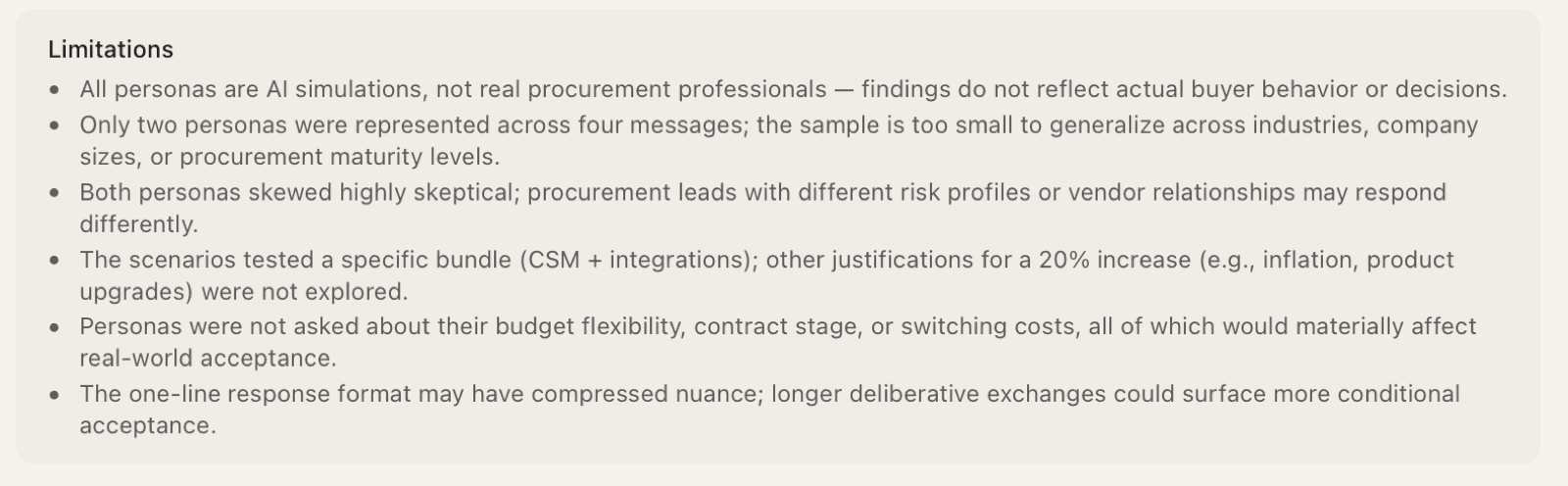
- Compile. The report reads up to 12 conversations, the last 60 messages of each, with their verdicts, withheld thoughts and trust shifts. It writes a summary, up to 8 findings each with a confidence, up to 6 evidence items per finding, the limitations, and the method: personas, artifacts, and the knowledge they were grounded in.
- The rule. An evidence item must cite a real turn or it is dropped. “View turn” opens that reply in the inspector.
- Then it is yours. Edit the summary, the claims and the limitations in place. Export Markdown. Re-compile when the study grows; it warns before overwriting edits.

They remember, and it changes them.

- Memory is retrieved by relevance, emotional weight and recency, so what a persona brings up is what mattered to it.
- Emotion belongs to the conversation. It is still there when you come back, settles back toward the persona’s baseline over hours, and a new conversation starts from the baseline. Trust starts at 50 and never decays on its own.
- Feed them experiences. Paste text or a document and the persona forms memories and learns facts from it, which then count as knowledge.
- Beliefs move. Repeated, argued challenges accumulate as evidence; past a threshold that depends on the persona, the belief is rewritten and the change is recorded as a memory.
Straight answers.
What do I need to build a persona?
Anything real about the person or segment: interview transcripts, a brief, a customer profile, documents. The AI builder derives a full profile from it and shows an evidence quote and a confidence for every field. You can also start from scratch on the 16-dimension profile or from one of 15 templates.
How does a persona use my documents?
You attach sources to the persona with a fluency: native, trained, familiar or aware. In grounded mode the persona prefers that material for domain facts and shows what it drew on with each reply. In strict mode it answers specific facts only from the material and its memories, and says it does not know beyond that, in character.
How big can a focus group be?
Two to eight personas. Moderated groups answer each moderator message in turn. Autonomous groups run for up to 50 turns on their own; you can pause, interject and resume.
What is in the report?
A summary, up to eight findings each with a confidence, up to six evidence items per finding, limitations, and the method: which personas, how many artifacts, and which knowledge sources were used. Every evidence item cites the exact reply it came from. Evidence that cannot cite a turn is dropped before the report is written.
Can I export?
Conversations and focus groups export as Markdown or plain text, and a conversation export can include the inner world. Reports export as Markdown. Your whole account exports as one JSON file from Settings, and you can delete the account and everything under it yourself.
Is the Live view available?
Not yet. A full-screen view that replays each reply’s reasoning as it happened is built and awaiting deployment. This site will say so the day it ships.
Private beta · by application
Bring one real research question.
Access opens by application. Tell us the question you are trying to answer and who has to be convinced by the result.
A rehearsal, not a replacement, for talking to real customers. Stated in the product and in the terms. Every exported report ends with the line that personas are AI simulations, not real customers.